
Recurring competition
A league needs an operator, repeatable format and public event record. A viral demo or one-off bracket is not automatically a league.
01Field explainerAnswer-first / sourced entities
The category spans combat exhibitions, one-off tournaments, active leagues and multisport events. Project H distinguishes them before comparing them.
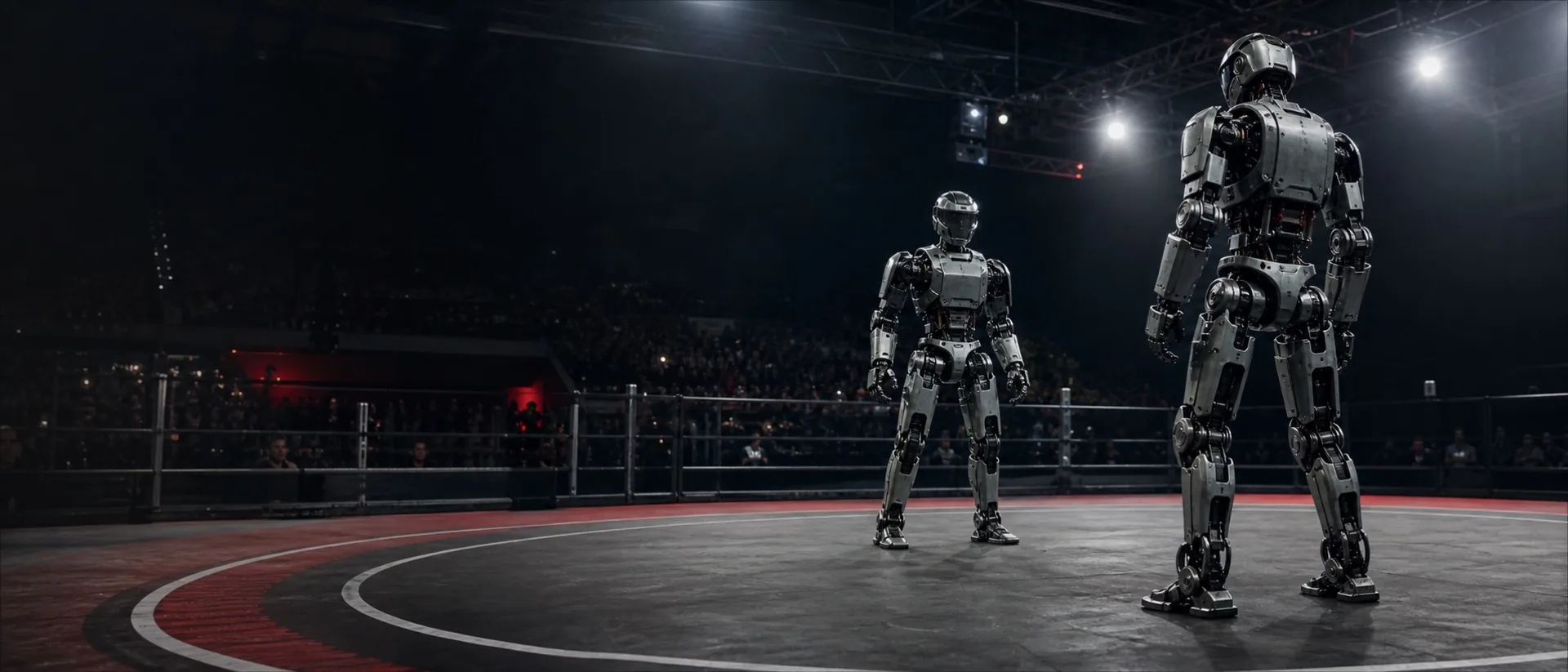
Reading boundaryNon-documentary category illustration
The image explains a generic category environment. It is not a robot portrait, event record or result source.
A league needs an operator, repeatable format and public event record. A viral demo or one-off bracket is not automatically a league.
01Iron Fist King is valuable because its bracket is documented, but it remains a one-off tournament rather than a continuing league.
02Official film can show that a fight occurred. Results and standings still require an explicit organiser or source record.
03Project H’s current field contains six active anchors with a documented humanoid-combat relationship: URKL, Robot Embodied Kombat, Ultimate Fighting Bots, Shadow Combat League, the World Humanoid Robot Games free-combat programme and Japan’s ROBO-ONE.
They do not form a governing federation, and several are early-stage. The point of the list is not to manufacture equivalence; it is to create a verified perimeter. Each anchor has an operator or institutional record, a competition format and a source trail strong enough to distinguish it from a demo, television property or non-humanoid robot event.
URKL positions full-size autonomous decision-making at the centre of its rules. REK connects pilots through VR and motion capture. UFB uses remote gamepad control. Shadow Combat League describes a teleoperated experience around VR/mocap. WHRG contains multiple event contracts rather than one universal mode, while ROBO-ONE includes a distinct autonomous small-robot category.
This is the most important map in the sport. A control system determines whether a bout primarily tests a pilot, a policy model, a perception stack or the integration between them. The word humanoid describes the body; it does not describe the competitive intelligence.
Several names repeatedly counted as humanoid fighting leagues fail an entity check. Iron Fist King is a documented one-off Unitree G1 boxing tournament and product variant, not a recurring league. Mecha King is an EngineAI predecessor event rather than an independent competitor to URKL. NHRL stages destructive non-humanoid robot combat. Robot Combat League is a 2013 Syfy television series. ProRL is a racing project.
Removing those false positives makes the category look smaller, but much more useful. A clean field supports accurate schedules, results and future markets. An inflated field produces dead calendars, duplicate entities and comparisons between sports that do not share a body plan or outcome contract.
URKL has the strongest published rules contract but an incomplete public season record. REK supplies a clear pilot-led counter-model. UFB pairs remote competition with a creator-led distribution network. Shadow Combat League shows how crypto-native sport infrastructure may attach itself to robot competition. WHRG connects combat to a large institutional multisport event. ROBO-ONE supplies the historical continuity most Western coverage misses.
Together they explain why Project H is multi-league. No single organiser currently provides enough repeated events, entity depth and public results to support an independent category desk. The combined graph is larger than any one season while preserving the boundaries between sports.
The next threshold is not another viral clip. It is repeated public competition data: stable event dates, named entrants, complete brackets, machine identities, control declarations and official result notices. Those records enable standings, head-to-heads and prediction questions that can resolve without editorial guesswork.
Until then, the category should be covered as a forming sports ecosystem. Project H can publish what happened, compare rules and expose conflicts, but it should not backfill world rankings, undocumented team rosters or synthetic probabilities simply because mature sports products usually contain them.
Reader questions3 direct answers
The defensible 2026 field contains six anchors: URKL, REK, UFB, Shadow Combat League, WHRG free combat and ROBO-ONE.
No. It is an important robot-combat benchmark, but its machines and competition contract are not humanoid.
No. It is best documented as a one-off Unitree G1 boxing tournament and product variant with a complete public bracket.
Evidence register8 source records
Primary URKL format and autonomy source.
REK identity, hardware and pilot-control context.
UFB format and event context.
Institutional multisport field and combat-event context.
Official evidence that Iron Fist is attached to the boxing product/event context, not a standalone league.
Non-humanoid destructive robot-combat boundary.
Official Japanese reference; cited textually pending inclusion in the outbound-link whitelist.
Teleoperated league context; retained as an adjacent source with explicit confidence limits.