
Autonomous or pilot-led?
URKL delegates competitive decisions to the robot. REK uses VR and motion capture; UFB uses gamepad control. These formats cannot share one performance ranking.
01Category primerAnswer-first / sourced entities
A robot fight is not one universal sport. Hardware class, control mode, scoring and recovery rules change the meaning of every result.
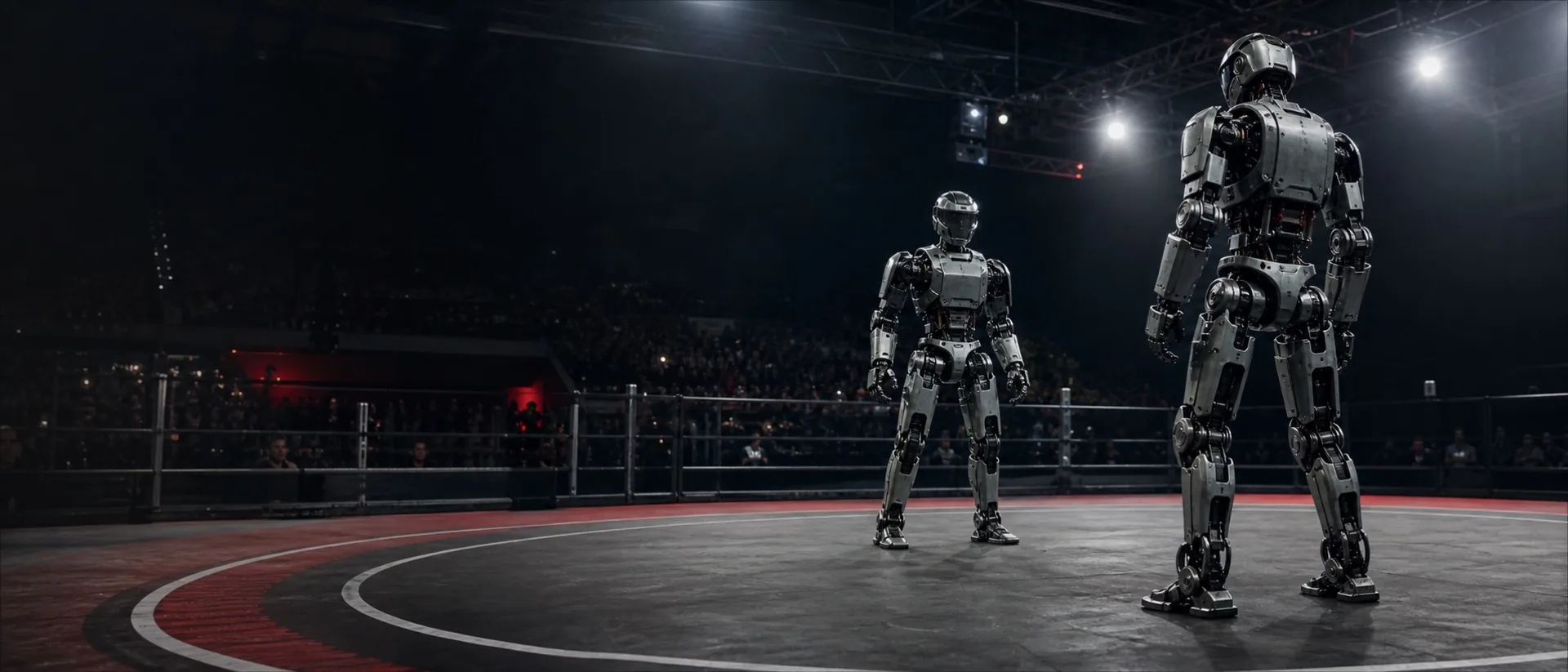
Reading boundaryNon-documentary category illustration
The image explains a generic category environment. It is not a robot portrait, event record or result source.
URKL delegates competitive decisions to the robot. REK uses VR and motion capture; UFB uses gamepad control. These formats cannot share one performance ranking.
01URKL supplies a standard T800 and forbids core hardware modification. Other events allow multiple platforms or configure the same platform differently.
02A result needs a published scoring contract. Highlight footage can document an incident, but it cannot invent a judge scorecard.
03The phrase robot fight describes a visual outcome, not a shared sporting contract. A wheeled machine built to disable an opponent, a small biped judged on falls and a full-size humanoid scoring effective strikes may all appear in the same search result while competing under incompatible rules.
Project H therefore starts with the competition file, not the highlight. The operator, hardware class, control mode and scoring document determine what viewers are actually watching. Without those four fields, a knockout clip is entertainment evidence—not a comparable sporting result.
Autonomous and teleoperated bouts can look almost identical after the bell. The important difference sits upstream. URKL’s published rules prohibit joysticks, remote controls and motion controllers during competition, and Chinese reporting describes in-bout decisions as AI-led. REK instead connects a human pilot through VR and motion capture, while UFB uses remote gamepad control.
That distinction changes the meaning of speed, defence and recovery. In a pilot-led format, performance belongs to a human-machine pair. In an autonomous format, perception, planning and control software become part of the competitive athlete. A combined ranking would erase the skill being tested.
A standardised platform narrows the contest toward software and preparation; an open field makes hardware engineering part of the result. URKL centres its tournament on EngineAI’s full-size T800 and restricts core modification. REK has used Unitree G1 and H1-class machines. UFB has presented a broader mix of Unitree, Booster and related platforms.
Size matters just as much as brand. ROBO-ONE has supported humanoid combat for decades, including an autonomous category, but its robots operate around a four-kilogram class. It is historically essential and technically distinct from a full-size humanoid league. “Autonomous” alone is not enough to make two records comparable.
The URKL V1.0.0 rules publish a points ladder for effective actions, a ten-second knockout count, a limit of two resets and an eight-metre competition circle. Tournament bouts are described as best-of-three rounds with five minutes of net time. Those mechanics are what makes a result checkable rather than a matter of opinion.
The Shenzhen opening gala used five exhibition rounds and ended 3–2 on points. That result is documented, but it should not be projected onto the later tournament format. Project H keeps exhibition records, tournament rules and future schedule claims in separate fields precisely because sports data becomes misleading when formats are flattened.
Video can prove that an event occurred and show a visible incident. It cannot, by itself, supply a judge scorecard, confirm a roster or resolve an unpublished round. The strongest record combines a pre-existing rules contract, an organiser or institutional result and independent reporting that names the same participants and outcome.
When one of those layers is missing, the interface should say so. Matador’s 3–2 gala win is confirmed across Chinese and English reporting, but no source publishes the individual round winners or judge totals. A trustworthy database preserves that absence rather than drawing a plausible-looking score timeline.
Reader questions3 direct answers
No. URKL is autonomous during the bout; REK, UFB and several other formats use a human pilot through VR, motion capture or a controller.
It depends on the published competition contract: points, falls, knockout counts, resets and tournament advancement are not standardised across leagues.
It can document visible action, but a score or bracket still needs a named result source and the applicable ruleset.
Evidence register6 source records
Primary Chinese rules source for control, format, scoring, resets and knockout mechanics.
Result, autonomy language and exhibition context, published 17 July 2026.
VR and motion-capture control context for REK.
Official historical reference; cited textually pending inclusion in the outbound-link whitelist.
Confirms the 3–2 result on 16 July 2026.
English-language corroboration of the result and fifth-round incident.